
High-Volume Collated Drywall Screws for Gypsum Board Installation: An Application Guide
Collated drywall screws change how a gypsum board crew works. Instead of reaching for a loose screw, loading it, and driving it one at a time, a collated strip feeds the next screw automatically into an auto-feed screwdriver. On a large partition wall or ceiling project, that difference compounds across thousands of fastening points per shift. This guide explains when collated drywall screws outperform loose screws in cycle time and consistency, how to match thread type and point geometry to the substrate, and how product specification, tool set-up, and supply planning interact on high-volume jobs.
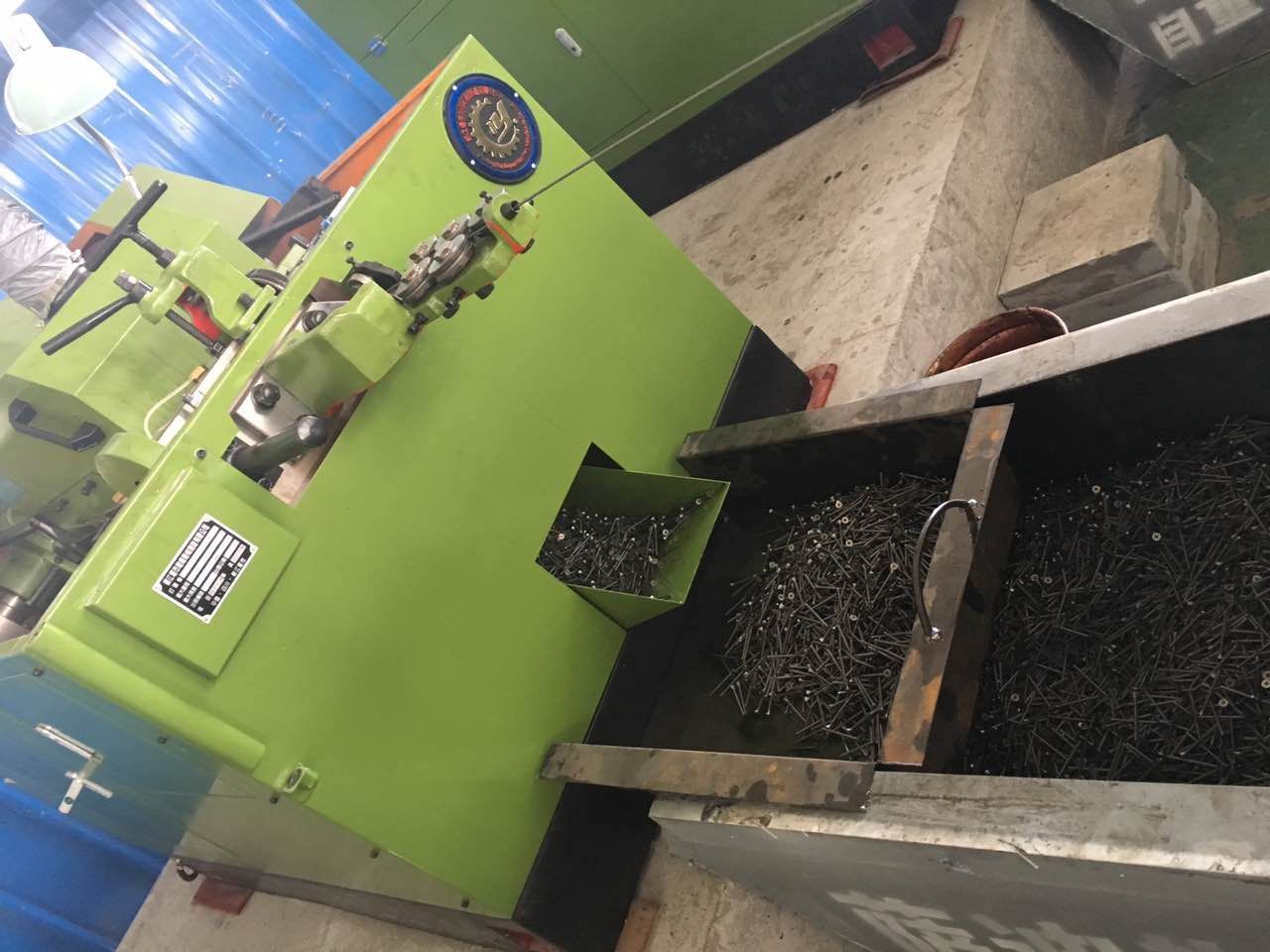
Cover image: Drywall screw production equipment at Weifeng Fastener. Source: Weifeng Fastener.
Why High-Volume Gypsum Board Work Demands a Fastener Decision
The decision point is straightforward: a gypsum board crew has a fixed labour pool and a fixed programme, and every second spent handling a single loose screw is a second not spent driving board. In high-volume installation, the fastener choice is not a consumable detail; it is a productivity input. That is why crews running auto-feed screwdrivers treat collated drywall screws as a system component rather than a commodity item.
Three conditions make the decision urgent:
- Large continuous areas. Partition walls, ceiling fields, and long corridors produce long uninterrupted runs where loading interruptions break rhythm and add handling time.
- Multiple crews on one programme. When several teams work the same specification, consistency of seating depth and drive angle becomes a quality-control issue, not just a speed issue.
- Programme pressure. Interior fit-out and construction engineering schedules rarely reward slow, deliberate single-screw work. They reward consistent output at an acceptable quality standard.
In these conditions, the relevant question is not whether collated screws cost more per piece. The relevant question is whether the installed cost per square metre of board, after accounting for handling time and rework, favours the collated system. This guide addresses that question using verifiable product facts and application logic.
Industry Background: What Drives Collated Drywall Screw Demand
Drywall screws are a large and growing fastener category. Published market research projects the global drywall screws market to grow from USD 2.18 billion in 2025 to USD 3.04 billion by 2033 (Source: SRC-0001, commercial research). Residential construction housing starts drive 58% of global drywall screw demand (Source: SRC-0001). These two figures together explain why fastener specifications that improve residential installation speed attract sustained attention.
The collated segment has its own demand signal. Collated drywall screws account for approximately 36% of product demand in the collated screw market, driven by modular and prefabricated construction (Source: SRC-1.8.2, commercial research). That share is a useful benchmark: collated screws are not a niche accessory. They are a mainstream configuration in projects where labour availability and schedule certainty matter.
Standards also shape the conversation. DIN 18182-1 specifies Type TN (trumpet head, double continuous thread) for 3.5 mm diameter drywall screws with lengths ranging from 25 mm to 55 mm (Source: SRC-0002, primary standard reference). For buyers and specifiers, this establishes a documented baseline against which product geometry and dimensional ranges can be compared. It does not, by itself, certify any supplier's product; standard reference and product conformity remain separate checks.
What Makes a Collated Drywall Screw Suitable for High-Volume Installation
A collated drywall screw is a drywall screw packaged in a linked strip or coil so that an auto-feed screwdriver can advance screws one after another without manual handling. The screw itself still has to perform as a drywall screw: seat the board, hold it to the substrate, and avoid damaging the paper surface. Three product features matter most in high-volume work.
Bugle head for controlled seating
The bugle head is the standard drywall screw head shape. It is designed to pull the board tight to the stud and then stop at the paper surface rather than cutting through it. In high-volume installation, a head that seats consistently reduces the number of over-driven or under-driven screws, which in turn reduces callbacks and surface repairs.
Weifeng Fastener's C1022A-PH-BUGLE drywall screw uses a bugle head and a Phillips #2 drive type. The model is available in a size range of 3.5 mm–4.8 mm (#6–#10) and a length range of 13 mm–150 mm (1/2"–6") (Source: Weifeng Fastener product data).
Sharp piercing point for direct engagement
A sharp piercing point allows the screw to penetrate the gypsum board and engage the substrate without a separate pilot hole. Published product data confirms that sharp point configurations are used on drywall screws intended for wood studs or 25-gauge metal studs (Source: EV-0009, product listing). For high-volume work, a sharp point that engages cleanly reduces the risk of the screw walking on the board surface before it bites.
Thread type matched to substrate
Thread selection is not cosmetic. Coarse threads are typically used for wood studs; fine threads are used for light gauge metal studs (Source: knowledge Q&A). The same source adds an important constraint: selection depends on stud thickness, point type, and specific product ratings, and installers should not assume interchangeability based on thread appearance alone. In high-volume work, a crew that mixes thread types across substrates creates a quality and traceability problem that is difficult to unwind later.
Material and hardness
Weifeng Fastener's C1022A-PH-BUGLE drywall screw is made of C1022A case hardened carbon steel, with a surface hardness of minimum 550 HV and a core hardness of 300–450 HV (Source: Weifeng Fastener product data). Case hardening produces a hard surface for wear resistance against the driver bit while retaining a tougher core. In high-volume driving, that combination is directly relevant to bit life and head-stripping risk.
When Collated Screws Outperform Loose Screws in Cycle Time and Consistency
Collated screws are not universally faster. They are faster under specific conditions, and the conditions are predictable.
Condition 1: long, uninterrupted fastening runs. When a crew is driving screws along a long partition or across a large ceiling field, the auto-feed system removes the pick-up and placement motion from every cycle. The benefit is greatest where the run is long enough for the crew to establish rhythm and stay in posture.
Condition 2: consistent board thickness and substrate. Collated systems favour repeatable conditions. Where substrate depth and board thickness are uniform, the driver's depth setting can be locked in and the crew can focus on pace rather than adjustment. Where conditions vary screw by screw, the advantage narrows.
Condition 3: available tool support. Collated screws require an auto-feed screwdriver matched to the strip or coil configuration. A crew without that tool cannot realise the cycle-time benefit, and a crew with a poorly maintained tool will see jam rates rise. Tool maintenance is therefore part of the fastener decision, not separate from it.
Condition 4: a quality standard that rewards consistency. In high-volume interior fit-out, the cost of a popped or over-driven screw is not the screw; it is the repair. Collated systems reduce the frequency of manual seating errors because the driver advances and seats each screw with a repeatable motion. That is the consistency argument, and it is the reason procurement teams on large partition contracts ask for collated configurations rather than loose cartons.
Step-by-Step Application Guide for High-Volume Gypsum Board Installation
Step 1: Confirm the substrate and thread type
Identify whether the stud is wood or light gauge metal before ordering. Coarse threads are typically for wood studs; fine threads are for light gauge metal studs (Source: knowledge Q&A). Measure steel stud thickness or wood moisture content, and match thread type to the product specification. Do not assume a thread will work across both substrates.
Step 2: Select screw length against board build-up
Length must account for board thickness plus penetration into the stud. Weifeng Fastener's catalogued range covers 13 mm–150 mm (1/2"–6") in 3.5 mm–4.8 mm (#6–#10) diameters, which covers common single-layer and multi-layer gypsum board build-ups (Source: Weifeng Fastener product data). Confirm the selected length against the project specification before bulk ordering.
Step 3: Set up the auto-feed tool before the first board
Load the collated strip according to the tool manufacturer's instructions, set the depth stop on a test piece of the actual board and stud combination, and drive a short test run. Check that the bugle head seats at the paper surface without tearing. Adjust the depth stop before production begins, not after the first wall is complete.
Step 4: Run a trial installation and inspect
Drive a test row and inspect for three failure modes: over-driving (head below the paper surface), under-driving (head proud of the surface), and stripping (bit spins without advancing the screw). If any appear, stop and correct the tool setting or confirm the screw specification. The knowledge base for drywall screw selection is explicit on this point: do not use wood-rated coarse threads in metal studs, and stop if stripping or poor engagement occurs (Source: knowledge Q&A).
Step 5: Standardise across crews
On multi-crew programmes, issue one screw specification per substrate and one tool setting per board build-up. Consistency across crews is a management decision as much as a product decision. A single reference sample per substrate helps crews self-check against an agreed standard.
Step 6: Monitor bit wear and jam frequency
Phillips #2 drive bits wear. In high-volume work, bit condition affects both cycle time and head-stripping risk. Track jam frequency and bit changes as routine maintenance signals. A rising jam rate is usually a tool or strip condition issue, not a screw specification issue, but it must be investigated before it affects the programme.
Step 7: Plan replenishment against the programme, not the pallet
High-volume installation consumes screws in predictable daily quantities. Plan replenishment against the installation programme so that strip configuration and screw specification remain consistent for the duration of the job. Changing specification mid-programme creates a mixed-installation risk that is difficult to audit later.
Use Cases: Where Collated Drywall Screws Fit Best
Weifeng Fastener states that the drywall screw product is applicable to interior decoration, construction engineering, gypsum board installation, partition wall construction, and furniture manufacturing (Source: Weifeng Fastener product data). Within those broad categories, collated configurations are most relevant in the following scenarios.
Gypsum board partition walls
Partition walls produce long, repetitive fastening lines. A crew working a full floor of partitions benefits from the reduced handling and consistent seating that a collated system provides. Coarse thread for wood studs and fine thread for light gauge steel studs should be specified per the wall type.
Ceiling installation
Ceiling work adds posture and reach constraints. Reducing the number of handling motions per screw matters more overhead than at waist height, which is why auto-feed systems are common on large ceiling fields. Board thickness and substrate depth should be confirmed before the depth stop is set.
Light gauge steel stud framing
Light gauge steel studs call for fine thread screws. The substrate is uniform, which suits a locked depth setting and a collated feed system. Stud thickness should be checked against the product rating before the crew begins.
Wood stud framing
Wood studs call for coarse thread screws. Wood varies more than steel in density and moisture content, so depth-stop verification on the actual job material is more important than on steel studs.
Prefabricated and modular construction
The growth of collated drywall screws is explicitly linked to modular and prefabricated construction demand (Source: SRC-1.8.2). In prefabrication, repeatable fastening conditions are the norm, which is exactly where a collated system performs best.
Comparison Table: Collated vs. Loose Drywall Screws and Thread Selection
| Decision factor | Collated drywall screws | Loose drywall screws |
|---|---|---|
| Handling model | Strip or coil feed into an auto-feed screwdriver; screw advanced by tool | Manual pick-up, placement, and driving per screw |
| Best-fit project profile | Long runs, multi-crew programmes, prefabricated and modular work | Small repair work, irregular layouts, low-volume jobs |
| Consistency mechanism | Repeatable tool-driven seating motion | Depends on individual operator technique |
| Tool dependency | Requires matched auto-feed screwdriver | Standard driver bit only |
| Market signal | Approximately 36% of product demand in the collated screw market, driven by modular and prefabricated construction (Source: SRC-1.8.2) | Baseline drywall screw format |
| Selection point | Coarse thread | Fine thread |
|---|---|---|
| Typical substrate | Wood studs | Light gauge metal studs |
| Selection checks | Stud thickness, point type, specific product rating | Stud thickness, point type, specific product rating |
| Interchangeability warning | Do not assume interchangeability based on thread appearance alone | Do not assume interchangeability based on thread appearance alone |
Sources: knowledge Q&A on coarse vs fine thread selection; Weifeng Fastener product data for C1022A-PH-BUGLE dimensions and hardness; SRC-1.8.2 for collated screw market share.
FAQ
What makes a drywall screw supplier a long-term partner for gypsum board partition contracts?
A long-term supplier relationship rests on repeatable product consistency, documented specifications, and reliable delivery. Weifeng Fastener's C1022A-PH-BUGLE drywall screw is made of C1022A case hardened carbon steel with a surface hardness of minimum 550 HV and a core hardness of 300–450 HV, and is catalogued in 3.5 mm–4.8 mm (#6–#10) diameters and 13 mm–150 mm (1/2"–6") lengths with bugle head and Phillips #2 drive (Source: Weifeng Fastener product data). The company holds ISO 9001 and CE certifications (Source: EV-0004) and positions itself as a long-term partner from technical drawing to final delivery. On the logistics side, Weifeng Fastener offers shipping from Ningbo, Shanghai, and Tianjin ports to support landed-cost planning (Source: Weifeng Fastener product data). For partition contracts that run over multiple phases, those combined factors matter more than a one-time unit price.
What is the difference between coarse thread and fine thread drywall screws?
Coarse threads are typically used for wood studs; fine threads are used for light gauge metal studs. Selection depends on stud thickness, point type, and specific product ratings. If a product manual allows multiple substrates, follow the manual, and do not assume interchangeability based on thread appearance alone (Source: knowledge Q&A). For high-volume crews, the practical rule is one thread type per substrate, confirmed against the project specification before the first board is driven.
When do collated drywall screws outperform loose screws in a large installation?
Collated screws offer their clearest advantage when three conditions align: long uninterrupted fastening runs, consistent board and substrate conditions, and a matched auto-feed screwdriver in good maintenance. Under those conditions the tool removes the pick-up and placement motion from every cycle and provides a repeatable seating motion. Where layouts are irregular, volumes are low, or tool support is absent, the advantage narrows. The decision should be made against installed cost per square metre, not unit price per screw.
What are the typical purchasing terms and acceptance criteria for high-volume drywall screw orders?
Weifeng Fastener's stated purchasing terms are: MOQ 300 kg; delivery terms FOB/CIF; acceptance criteria include pre-shipment test and third-party inspection; payment terms 30% T/T in advance, 70% T/T against copy of B/L (Source: purchasing Q&A). These terms apply to standard orders and provide a documented basis for high-volume replenishment planning.
How should logistics be planned to reduce landed cost on high-volume orders?
Weifeng Fastener offers flexible shipping from Ningbo, Shanghai, and Tianjin ports and aims to reduce total landed cost and total cost of ownership through multi-port logistics (Source: Weifeng Fastener product data). For a multi-phase partition contract, the practical approach is to confirm the port and consolidation plan at the quotation stage, then align delivery batches to the installation programme. Request the current catalog and confirm the latest MOQ, packing, and delivery terms with the sales team before finalising the order schedule.
Conclusion
Collated drywall screws are a system decision, not a packaging preference. They reward crews that run long, repetitive fastening lines with matched auto-feed tools and consistent board conditions. They do not replace good substrate matching, thread selection, or depth-stop discipline. On high-volume gypsum board partition and ceiling work, the winning approach is to specify thread type per substrate, confirm screw length against board build-up, lock the tool setting with a trial installation, and plan replenishment against the programme.
Weifeng Fastener supplies C1022A-PH-BUGLE drywall screws in 3.5 mm–4.8 mm (#6–#10) diameters and 13 mm–150 mm (1/2"–6") lengths, with bugle head, Phillips #2 drive, C1022A case hardened carbon steel, and surface hardness minimum 550 HV / core hardness 300–450 HV (Source: Weifeng Fastener product data). The company holds ISO 9001 and CE certifications and ships from Ningbo, Shanghai, and Tianjin ports.
Next step: confirm the specification for your programme
For high-volume partition and ceiling projects, request a specification review and sample set for the C1022A-PH-BUGLE drywall screw, or download the current Weifeng Fastener catalog to check dimensions, packing, and finish options. Contact: Tony@wf-fastener.com · WhatsApp: +86-13355841616 · Download the Weifeng Fastener catalog (PDF)
All product specifications in this article are drawn from Weifeng Fastener product data. Market and standards references are attributed to the cited sources. Application guidance is based on published product and selection facts; confirm final specification against your project drawings and local requirements.
Have Questions or Need More Details?
Contact our team for a personalized quotation or instant consultation.
Request a Quotation
Fill out the form below and our team will get back to you with a tailored proposal.
WhatsApp Direct Chat
Prefer to chat in real-time? Message us on WhatsApp for instant assistance & quick answers.
- Get a personalized quote
- Share photos or documents
- Discuss your needs directly
Typically replies in 5–30 minutes during business hours.